How to Tool Leather: A Beginner's Guide to Stamping
Learn how to tool leather from scratch: casing veg-tan, choosing stamping tools, setting up your slab, and striking clean impressions every time.
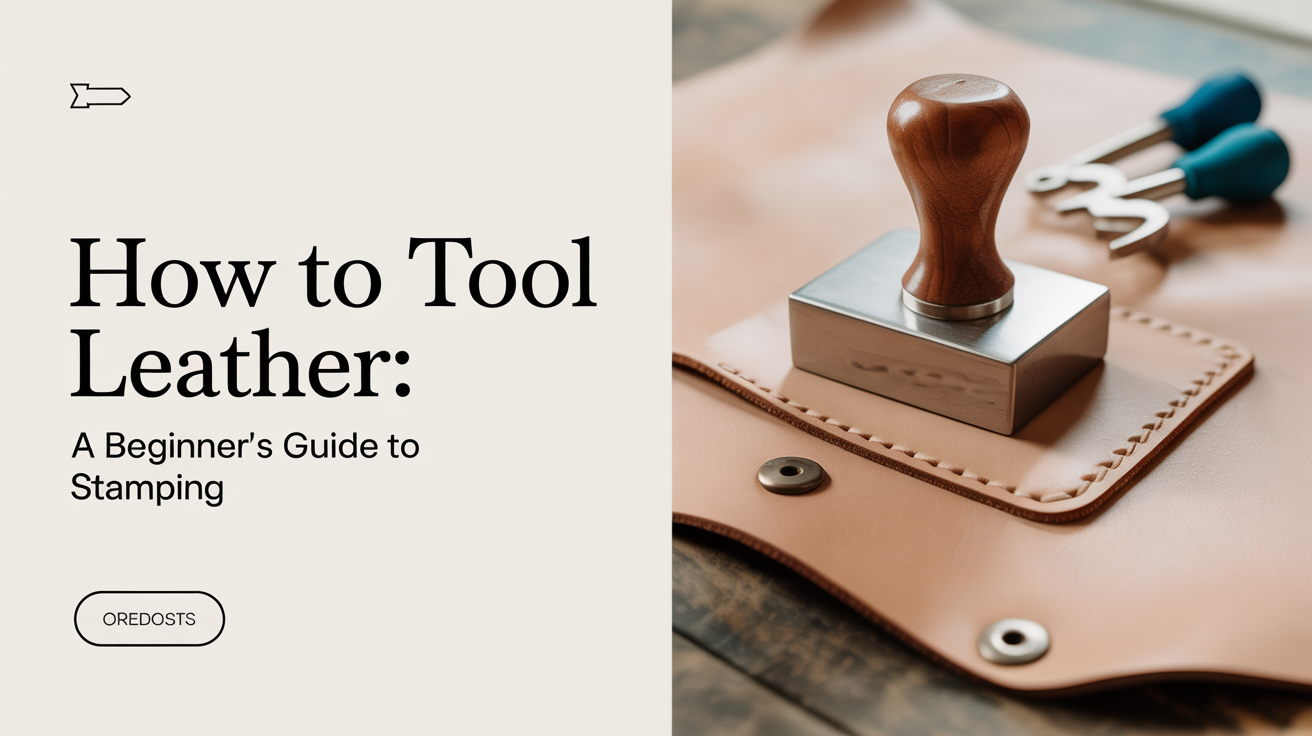
Tooling leather means pressing or cutting decorative impressions into the surface while the hide is damp enough to hold a mark but dry enough not to tear. Get that moisture balance right, and a simple set of stamps can produce work that looks genuinely considered.
Why Only Veg-Tan Leather Tools Well
This comes up constantly in beginner questions, and the answer is worth understanding rather than just accepting. Vegetable-tanned leather is tanned with plant-based tannins (oak bark, mimosa, chestnut) that leave the hide firm and slightly porous. When you wet it and press a stamp in, the fibers compress and hold that shape permanently as the leather dries.
Chrome-tanned leather, which covers the vast majority of garment leather, bag lining, and upholstery hide, is tanned with chromium salts in a process that takes hours rather than weeks. The result is soft, pliable, and resistant to water absorption. A stamp pressed into chrome-tan will spring back as soon as you lift it. The impression disappears. No amount of technique fixes this.
So when you buy leather for tooling, look specifically for vegetable-tanned tooling leather (sometimes labeled "tooling side" or "carving leather"). Hermann Oak, Wickett & Craig, and Springfield Leather all sell it by the side or the piece. Thickness between 3–4 oz (1.2–1.6 mm) suits stamps and light carving; 5–6 oz (2.0–2.4 mm) handles heavier belt or bag work.
Setting Up Your Work Surface
Tooling requires a firm, non-yielding surface beneath the leather. If your workbench has any give, the stamp energy gets absorbed and your impressions come out shallow and fuzzy.
The standard solution is a poundo board (a dense, slightly yielding polymer slab, sometimes called a marble or poly board) or a granite slab at least 2 inches (5 cm) thick. Poundo has a small amount of give that absorbs mallet shock without bouncing; granite is completely rigid and produces very crisp impressions but is harder on your hands over a long session. Either works. What doesn't work: a wooden cutting board, a rubber mat, or a folded towel.
Set the slab on a solid table at a height where you can strike downward comfortably with your elbow slightly bent. If you're hunching or reaching, your strikes will be inconsistent.
A few other things to have ready:
- A water bowl and a natural sponge or cellulose sponge
- Paper towels or a clean cloth
- A pencil or silver pen to transfer your design (optional for stamp work, essential for carving)
- Painter's tape to hold the leather in place without leaving marks
Casing the Leather: Getting the Moisture Right
This is the step beginners most often get wrong, and fixing it costs nothing except time.
Casing means wetting the grain side of the leather until it reaches the right working moisture. Too dry, and stamps produce shallow marks that fade as the leather relaxes. Too wet (soggy), and the fibers tear or the impression blurs as the surface slips.
The target is leather that has gone from its natural tan color to a medium, even-darker tone across the whole surface, with no shiny wet spots remaining. That stage is called case-damp.
To get there, dampen the grain side with a sponge and clean water. Work in circular motions to cover the surface evenly. Then set the piece aside for 5–10 minutes and let the moisture wick inward. The leather will first look dark and damp (too wet to stamp), then lighten slightly as surface moisture evaporates while the interior stays hydrated. When the color is even and the leather feels cool but not slick to the touch, you're ready.
If you're doing a long tooling session and the leather starts to dry out, re-dampen the back (flesh side) with the sponge rather than the grain. This draws moisture up slowly and gives you more working time without over-saturating the surface.
For more detail on this process, see our guide on how to wet case leather for tooling.
Stamping Tools and How to Use Them
A basic stamping kit for beginners doesn't need to be large. Five or six tools will cover most decorative work.
The Mallet or Maul
You'll use one of these to drive every stamp. They're not the same tool.
A rawhide or wooden mallet delivers a sharp, single-impact strike. It's the right choice for beginners because you can control the force of each hit and stop easily between strikes.
A maul (also called a leatherworker's maul) is a cylindrical weighted tool, usually 12–16 oz (340–450 g), with a wide striking face. It delivers a rolling, follow-through strike rather than a sharp tap. Experienced carvers prefer it for carving because the rolling action lets them move a swivel knife in a continuous stroke. For stamp work, both are fine.
Do not use a metal hammer. The hard face marks stamps and concentrates impact in a way that punches through rather than compresses.
Common Beginner Stamps
| Stamp | What It Does | Beginner Use |
|---|---|---|
| Geometric (bars, squares, diamonds) | Creates repeating border or fill patterns | Low skill floor; good for practice |
| Camouflage (camo) | Curved, overlapping impressions that fill negative space | The most-used stamp in Western-style tooling |
| Pear shader | Rounded teardrop; shades/deepens areas of a carved design | Pairs with swivel knife carving |
| Beveler | Angled face that pushes cut edges down and creates shadow | Core tool for acanthus and floral motifs |
| Backgrounder | Stippled or hatched face that textures background areas | Makes carved motifs "pop" visually |
| Seeder | Small round impressions for flower centers and accents | Very common in floral tooling |
Start with geometric stamps and a backgrounder before moving to the carving-dependent tools (beveler, pear shader). Those require a swivel knife cut to sit against, and the swivel knife is its own skill. Our beginner's overview of leather stamping tools and how to use them covers each one in more depth.
Striking Technique
Hold the stamp vertical, not tilted. Place it on the leather, confirm it's positioned where you want it, and strike once with medium force. Lift. Check the impression. If it's shallow, the leather may be too dry or your strike was too light. If the impression has a blurred edge or tore the surface, the leather was too wet.
Most beginners strike too softly and then hit multiple times, which produces a "double-stamped" blur. One firm strike beats two tentative ones. Practice the motion on scrap pieces until the depth feels consistent.
Move stamps in a deliberate pattern. For border stamps, align each impression by placing the stamp so one edge overlaps the previous mark by a few millimeters, keeping the pattern continuous.
Adding a Swivel Knife: First Steps
The swivel knife is what separates stamping (pressing tools into leather) from tooling in the fuller sense (cutting a design and then using stamps to develop it). You don't need it to start, but it expands what you can do considerably.
The blade rotates in the handle's barrel, which lets you steer around curves without lifting the tool. You hold it with the yoke between your index and middle finger, the barrel resting in the web of your hand, your index finger on top of the yoke to control pressure. The blade tilts away from you as you draw it toward you, creating a shallow angled cut.
Cut depth should be about half the leather's thickness. Too shallow and the beveler has nothing to tuck under; too deep and the leather may crack at the cut when flexed.
Practice straight lines, gentle curves, and tight curves on case-damp scrap before touching a finished piece. The swivel knife rewards patience. For a full walkthrough of blade angles, sharpening, and cutting technique, see our guide on how to carve leather with a swivel knife.
Finishing the Tooled Surface
After tooling, let the leather dry completely before applying any finish. This takes anywhere from a few hours to overnight depending on humidity and how wet the leather got during casing. Don't rush it with a heat gun; uneven drying causes the leather to warp or the tooled areas to lose definition.
Once dry, the impressed areas benefit from a light application of neatsfoot oil or leather conditioner to restore suppleness. Apply sparingly and buff with a soft cloth. The tooled impressions will hold their depth.
If you want to highlight the pattern, apply a leather antique paste (a dark gel that settles into low areas) and wipe the high points clean before it sets. This dramatically sharpens the visual contrast between impressed and flat areas. Tan Kote or Resolene applied afterward seals everything.
FAQ
Does the leather need to be wet to stamp it?
Yes, for any permanent impression. Dry veg-tan will accept a light mark that mostly disappears as the fibers spring back. Case-damp leather compresses properly and holds the stamp geometry once it dries. The moisture is temporary; the impression is not.
Can I tool leather from a craft store?
Check the label carefully. Most leather at general craft retailers is chrome-tanned and will not hold tooling impressions. Look specifically for "tooling leather" or "veg-tan leather" on the packaging. If the product page or label doesn't specify veg-tan, assume it's chrome-tanned.
How hard do I need to hit the stamp?
Hard enough to produce a clean, even impression in one strike. The right force varies with the stamp size and leather thickness. A rough guide: start with a medium strike, check the depth, then adjust. Most beginners underestimate the force needed and end up hitting two or three times, which muddies the impression. Better to test on scrap first.
What's the difference between tooling and stamping?
In practice the terms overlap, but there's a useful distinction. Stamping usually means pressing a pre-made tool into the leather to create its shaped impression, often in a repeating pattern. Tooling in the broader sense includes cutting a design with a swivel knife first, then using stamps (beveler, pear shader, camo, backgrounder) to develop and shade that cut design. All tooling involves stamps; not all stamping involves a swivel knife.
Why does my stamp impression look fuzzy or doubled?
Two likely causes. First, the leather was too wet when you stamped; let it reach the case-damp stage (darkened but not shiny). Second, the stamp moved between strikes; press the stamp firmly against the leather before and during the strike to prevent any shift. Doubling (a shadow impression beside the main one) usually means the stamp rocked or skipped sideways.