Beginner Leather Stamping Tools and How to Use Them
A practical guide to beginner leather stamping tools: which stamps to buy first, how to case leather, and striking technique for clean impressions.
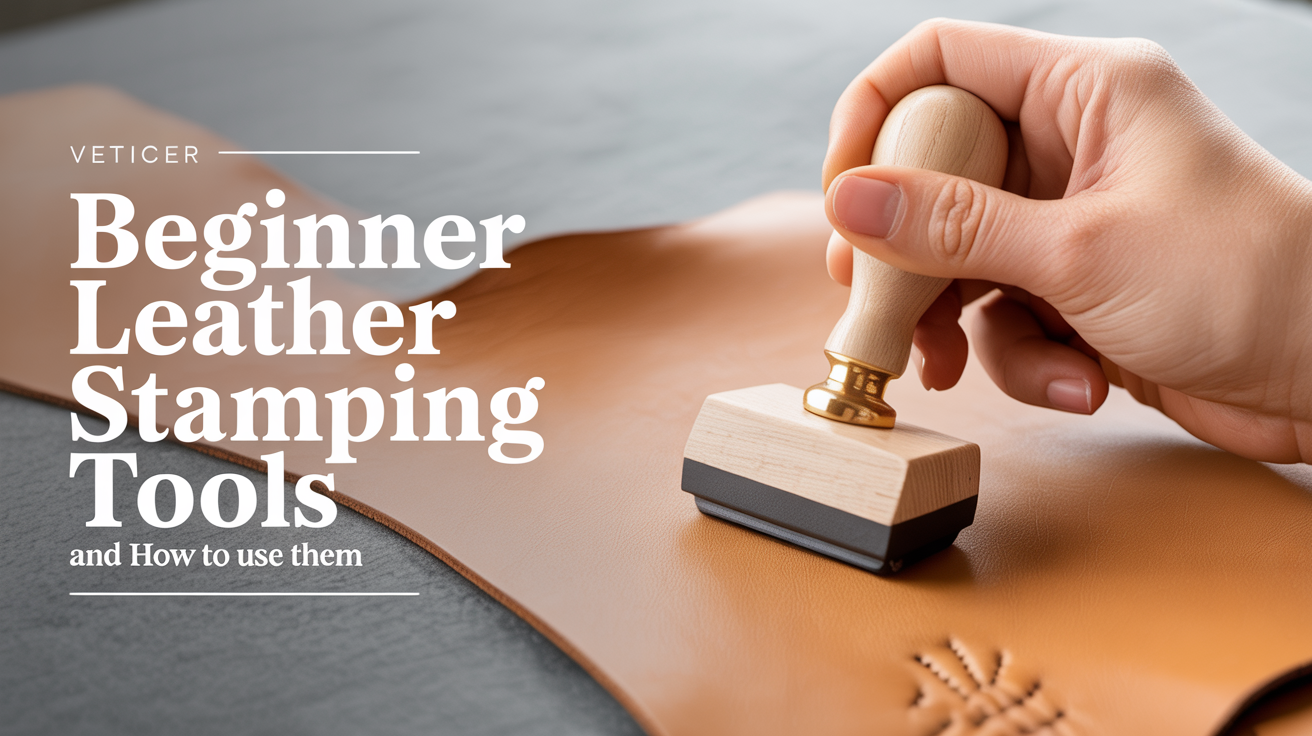
Leather stamping lets you press repeating shapes and textures into vegetable-tanned leather, building up patterns that look far more complex than the individual tools that make them. If you're just getting started, you need a small, deliberate set of stamps and a clear process, not a 300-piece kit that collects dust.
At a Glance
- Stamping only works on vegetable-tanned leather that's been properly cased (dampened); chrome-tan won't hold an impression.
- Start with seven stamps: a beveler, pear shader, seeder, backgrounder, veiner, and two geometric/basketweave tools. That set covers floral tooling, backgrounding, and stand-alone patterns.
- Stamp on a dense, hard slab (marble, granite, or poundo board), never directly on a wooden tabletop.
- Use a leather maul, not a metal hammer, and strike once per placement with a smooth, controlled blow.
- The casing "sweet spot" runs roughly 15 to 30 minutes after wetting, depending on leather weight; work in sections on larger pieces so you're always stamping inside that window.
- Basketweave and geometric stamps need no swivel-knife skill, making them the easiest entry point if you want to skip carving for now.
What You're Actually Doing When You Stamp Leather
A stamp is a hardened steel rod with a shaped tip. You press it against damp leather, strike the flat top with a mallet, and the tip pushes a permanent impression into the hide. The key word is "damp": dry leather cracks and resists the stamp, while waterlogged leather mashes unevenly. The technical term for getting the moisture right is casing, and it's the single biggest variable in whether your impressions come out crisp or muddy.
The leather must be vegetable-tanned (veg-tan). Chrome-tanned leather, which makes up the bulk of garment and bag leather, does not hold tooled impressions. According to Wikipedia's entry on vegetable tanning, vegetable-tanned hide "is not very flexible" and is the type used for luggage, footwear, belts, and other structured goods, while chrome tanning produces a stretchier leather suited to garments and handbags. That stiffness is exactly why veg-tan takes and holds a stamped impression: the fibers compress and stay compressed, instead of springing back like a chrome-tanned hide would.
One thing that trips up beginners buying their first hide: leather that's already been heavily oiled or conditioned cases poorly. Oils fill the pores that water needs to enter, so the leather resists absorbing moisture evenly and the casing window shrinks or disappears. If you're working with a piece that's had dressing applied (an older side, a remnant from another project), expect the casing step to take longer and the impressions to come out slightly softer than on fresh, dry veg-tan.
Before you touch a stamp, read the how to wet-case leather for tooling guide; it will save you a lot of frustration and wasted leather.
The Core Stamp Families
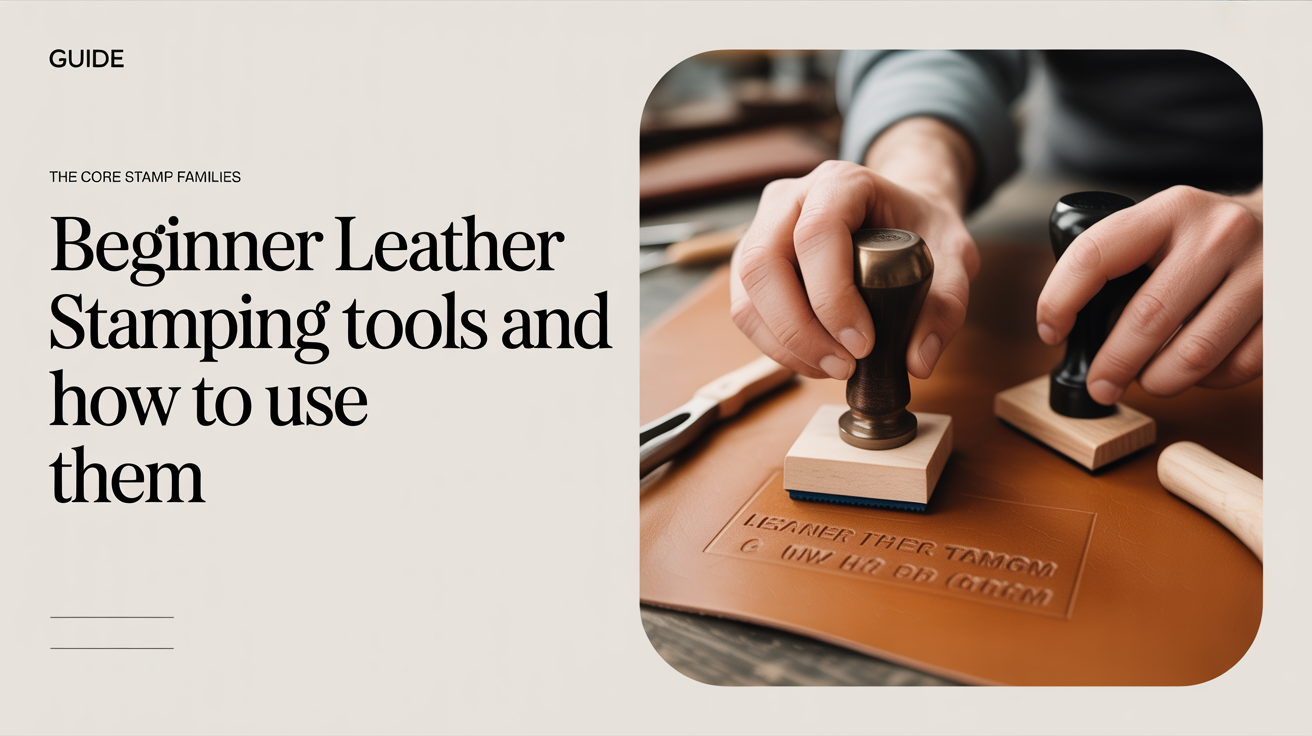
Stamps are grouped by the job they do in a design. You don't need every family on day one, but understanding what each one does helps you buy strategically.
Beveler (B-codes)
The beveler is the most fundamental stamp in Western-style floral tooling. After you cut a design with a swivel knife, the beveler presses down one side of the cut line, creating a shadow that makes the motif appear raised. The working face is a slightly curved, angled wedge. You walk it along the cut in overlapping strikes. Without a beveler, carved designs look flat and undefined.
Tandy's B197 and Barry King's angled bevelers are common references; the number after the letter usually indicates the stamp's width or face texture. A size that's too wide for the cut you're beveling will ride up onto the flat leather on either side and leave unwanted texture there, so match the beveler width to the tightest curve in your design, not the widest.
Pear Shader (P-codes)
Where the beveler creates directional depth, the pear shader adds rounded volume. It has a smooth, oval face and is used to shade petal centers, leaf surfaces, and anywhere you want a soft depression. You rock it slightly with each blow rather than keeping it perfectly vertical, which creates gradations rather than a single flat dent. A common beginner error is rocking too far in one direction, which leaves a visible hard edge on one side of the shaded area instead of a smooth taper.
Camouflage Stamp (C-codes)
Despite the name, camouflage stamps have nothing to do with military patterns. The name comes from their use in "camouflaging" the background by tying leaf and petal elements together. The face has a crescent or multi-lobed shape. They're used in floral and Sheridan-style tooling to connect motifs at their bases.
Seeder (S-codes)
A seeder has a small circular or dotted face and places a tight cluster of round impressions, traditionally at the centers of flowers. Simple, fast, and satisfying to use. It's usually the last stamp applied in a floral cluster, once the beveling, shading, and veining are already in place.
Veiner (V-codes)
The veiner leaves a curved line impression that simulates the central vein of a leaf. It comes in different curve radii to match different leaf sizes. You position it along the leaf axis and strike once per placement, lifting and repositioning rather than walking it. Buy at least two radii (a tighter and a wider curve) so you're not forcing one veiner shape onto every leaf size in a design.
Backgrounder (BG-codes)
After you've tooled the foreground motifs, the surrounding leather needs texture to push those motifs forward visually. A backgrounder has a fine pebbly or woven face and is walked across the background, covering it evenly. This is repetitive work but transforms a mediocre tooling into a professional-looking piece. Plan for backgrounding to take roughly as long as the rest of the design combined; rushing it is the most common reason a finished piece still looks flat.
Basketweave / Geometric Stamps
Basketweave stamps replicate the over-under pattern of woven material. The classic setup is a checkerboard stamp (X511-style) used in a diagonal grid, with each successive stamp offset by half a unit. Geometric stamps (triangles, diamonds, crosses) follow a similar grid logic and don't require any carved lines underneath. These are excellent beginner stamps because you don't need swivel-knife skills to use them.
A Sensible Starter Set
You don't need to spend a lot to start stamping well. Here is a practical first set with the job each tool does:
| Stamp | Type | What It Does |
|---|---|---|
| B200 (or equivalent) | Beveler | Shades cut lines to create depth |
| P206 | Pear Shader | Adds volume to petals and leaves |
| F889 | Flower Center / Seeder | Places seed impressions in flower centers |
| S703 | Background Pebbler | Textures background areas |
| V407 | Veiner | Marks leaf center veins |
| X511 (or half-check) | Basketweave | Stand-alone geometric fill pattern |
| Geometric triangle | Geometric | Border work and standalone patterns |
This seven-stamp set covers basic floral tooling, backgrounding, and standalone geometric patterns. A 30-piece beginner kit often includes redundant sizes of the same stamp family, which adds clutter without expanding what you can actually make. Expect to pay $6 to $15 per stamp buying individually from a leather supplier, so the full seven-piece set lands somewhere around $60 to $90, roughly the price of a mid-tier 30-piece kit with none of the redundancy.
For a wider look at carving tools alongside stamps, the how to carve leather with a swivel knife guide covers the cutting step that most floral stamping relies on.
Your Working Surface and Mallet
Two setup items matter as much as the stamps themselves.
The slab. Stamp on a dense, smooth, hard surface. Marble or granite slabs are the standard recommendation, they have the mass to absorb mallet energy without bouncing it back, and they stay put. A poundo board (dense nylon) works and is quieter, but marble gives better energy transfer. A wooden table flexes too much and produces soft impressions. A 12x12-inch marble tile from a hardware store costs a few dollars and works perfectly.
The mallet. Use a leather maul (rawhide-wrapped or polymer head) rather than a metal hammer. A mallet distributes force evenly and doesn't damage the stamp tops. Weights run from about 12 oz for detail work to 16 to 20 oz for backgrounders and basketweave. Most beginners do fine with a single mid-weight maul around 16 oz. Hold the mallet near the end of the handle, not choked up near the head. You get more controlled force from the full swing weight.
How to Hold and Strike for a Clean Impression
This is where most beginners go wrong. They either hit too softly (shallow impression that doesn't read) or too hard (the stamp buries in and mushes the surrounding leather).
Hold the stamp upright, perpendicular to the leather surface. If it tilts, one edge of the impression will be deeper than the other. Use two or three fingers to steady the shaft, with your thumb free. Keep your wrist loose.
Strike once per placement with a single, smooth blow, not a series of taps. Multiple light taps rock the stamp and blur the edges. One controlled strike is cleaner every time.
To check your depth before committing to a full piece, keep a scrap of cased leather beside your work and test there first. The impression should be visible and clean-edged, pressing the leather down roughly 1 to 2 mm depending on the stamp size. Three common problems and their fixes:
- Impression too shallow to read. You're pulling the blow. Commit to one firm strike instead of easing into it; a hesitant swing transfers less force than you think.
- Impression blown out with cracked edges. The leather was too dry when you struck it, or you hit far too hard. Recase the piece and test your force on scrap first.
- Uneven edges on an otherwise good impression. The stamp tilted mid-strike. Anchor your steadying fingers more firmly and check the slab is sitting flat before the next strike.
When walking a stamp (bevelers, backgrounders), each placement should overlap the previous by about one-third. This eliminates gaps and keeps the texture uniform.
Casing and the Working Window
Casing leather means wetting it evenly so it's workable, then letting it return to a specific moisture level before you stamp. Too wet and the impressions are mushy; too dry and the leather resists and cracks.
The process: wet the leather surface evenly with a damp sponge, then wait. As the leather dries from dark brown back toward its natural tan color, there's a window where it takes impressions best: typically when the leather is just slightly darker than dry and cool to the touch. That window varies mainly with leather thickness, which is worth planning around rather than guessing at:
| Leather Weight | Approx. Working Window After Casing | Notes |
|---|---|---|
| 2 to 3 oz (0.8 to 1.2 mm) | 10 to 15 minutes | Dries fast; work small sections |
| 4 to 5 oz (1.6 to 2 mm) | 15 to 25 minutes | Most common tooling weight |
| 6 to 7 oz (2.4 to 2.8 mm) | 25 to 35 minutes | Holds moisture longer, forgiving for beginners |
| 8 oz+ (3.2 mm+) | 35 to 45 minutes | Needs a firmer strike to reach full depth |
Ambient temperature and humidity shift these numbers too: a dry, warm workshop shortens the window, and a cool, humid one stretches it. If you're consistently missing the window, case a smaller area at a time rather than trying to speed up your stamping.
Work in sections if you're covering a large piece. Stamp the section while it's in the window, then move on. The how to tool leather a beginner's guide to stamping covers the full workflow from casing through finishing.
FAQ
Can I use regular craft leather for stamping?
No. Stamping only works on vegetable-tanned (veg-tan) leather. Chrome-tanned leather, which is what most fashion and craft-store leather is, doesn't hold impressed shapes because the tanning chemistry leaves the fibers too flexible and springy. Look specifically for veg-tan tooling leather, usually sold as "carving leather" or "tooling cowhide."
Do I need a swivel knife before I can start stamping?
Not necessarily. Geometric stamps and backgrounders work directly on bare cased leather without any carved lines. Basketweave patterns are entirely stamp-only. The swivel knife becomes necessary when you're doing floral and Sheridan-style designs, where carved outlines guide the beveler. If you want to start even simpler, basketweave is a great first project.
What's the difference between a maul and a mallet?
Both are used to strike stamps, but a leather maul typically has a rawhide or dense polymer head and is specifically designed for leatherwork. A mallet is a broader term covering wood and rubber versions. What you're avoiding is a metal-headed hammer, which concentrates force in a small area, damages the flat top of your stamps over time, and gives you less control. A 14 to 16 oz rawhide maul is the go-to for most beginners.
My impressions keep coming out with one deep side and one shallow side. What's wrong?
The stamp is tilting when you strike. Hold the barrel more firmly before the blow, keep your elbow over the stamp rather than off to the side, and check that your slab is level. Even a slight table tilt causes one-sided impressions. Some leatherworkers hold the stamp between their index and middle fingers with the shaft running along their palm, which gives more surface contact and reduces tilt.
How do I clean and store my stamps?
After a session, wipe the faces with a dry cloth to remove any leather residue. If there's buildup in the recesses, a soft brass brush (like a gun-cleaning brush) works well without scratching the steel. Dry them fully before storing. Rust pits steel quickly. Keep them in a roll-up canvas pouch or a block drilled with holes sized to hold each stamp upright, face-down to protect the tip.
How many strikes does a typical stamp actually need before it's worn out?
Steel stamps from reputable makers last for tens of thousands of strikes with normal use; wear shows up as softened edges on the face rather than sudden failure. What kills a stamp faster than use is corrosion from being stored damp or struck with a metal hammer, which peens and deforms the flat top. Buy once from a maker with a solid reputation and a well-maintained stamp will outlast several projects' worth of leather.