How to Start Leathercraft: A Complete Beginner's Guide
Learn how to start leathercraft for beginners: leather types, essential tools, your first project, and simple techniques to build real skill fast.
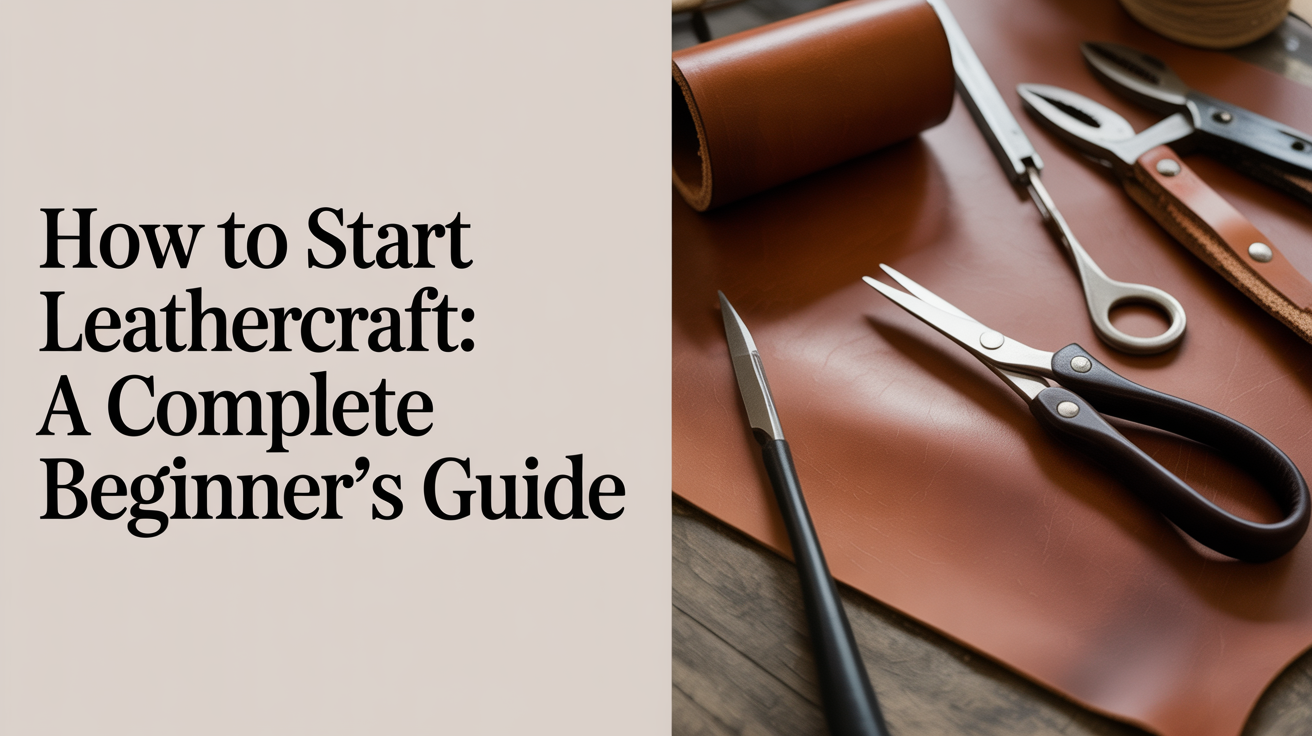
Leathercraft is one of the most accessible hand crafts you can pick up at home. A decent first project (a key fob or a simple card sleeve) is achievable in an afternoon with maybe $40 in materials and a handful of basic tools.
Here is what you actually need to know to get started without wasting money or getting frustrated.
Understanding Leather Before You Buy Any
The single biggest mistake beginners make is buying the wrong leather. Leather is graded by how it was tanned, its thickness, and the part of the hide it came from. Get these wrong and you will fight your material on every cut and stitch.
Vegetable-tanned vs. chrome-tanned
Vegetable-tanned leather (veg-tan) is tanned with plant-derived tannins over weeks or months. It is firm, takes tooling and carving beautifully, burnishes to a glassy edge, and develops a rich patina with use. Almost everything you see in traditional leathercraft tutorials uses veg-tan. It is your default choice.
Chrome-tanned leather is processed with chromium salts in a few hours. It is softer, more water-resistant, and cheaper. Great for garments and soft goods, but it will not tool, burnish edges cleanly, or behave well for most beginner projects. Buy it later, once you know what you are doing.
Thickness (weight)
Leather is sold by weight, where one ounce roughly equals 0.4 mm of thickness:
| Weight | Approx. Thickness | Best For |
|---|---|---|
| 2–3 oz | 0.8–1.2 mm | Linings, thin wallets |
| 4–5 oz | 1.6–2.0 mm | Card sleeves, key fobs, straps |
| 8–9 oz | 3.2–3.6 mm | Belts, thick-walled bags, holsters |
For a first project, 4–5 oz veg-tan is the sweet spot. It cuts cleanly, holds its shape, and is stiff enough that stitching holes stay open while you work. Buy a small piece (a square foot or two) rather than a whole side until you know you enjoy the craft.
Where to buy
Look for online leather suppliers that sell by the square foot or sell small project packs specifically for beginners. Avoid the hardware store and most craft chains; that leather is usually chrome-tan scraps with no thickness markings.
The Tools You Actually Need (and a Few You Can Skip)
You do not need a full workshop. A surprising amount of leatherwork fits on a kitchen table. That said, cutting corners on a few key tools will make you miserable.
The short list for a first project
- Round knife or head knife: for freehand cutting curves and trimming edges. A $15–25 beginner round knife that you keep sharp will outperform a $60 knife you never sharpen.
- Steel ruler and cutting mat: for straight cuts. A metal ruler is non-negotiable; a plastic one will give you a ragged edge every time.
- Stitching chisels or pricking irons: for marking and punching stitch holes. Diamond-point chisels (also called pricking chisels) give a clean angled hole ideal for saddle stitching. A 4 mm spacing is standard for most work; 3 mm for finer pieces.
- Two blunt-tipped harness needles: leatherworking needles are larger and blunter than sewing needles. You use two at once for saddle stitch.
- Waxed thread: linen or polyester, pre-waxed or waxed by you with beeswax. #532 linen is a good all-around weight.
- Mallet or maul: a wooden or poly mallet to drive the chisels. A hammer works in a pinch but damages chisel shanks faster.
- Edge beveler: a small #1 or #2 edge beveler removes the sharp corner from cut edges before burnishing. Do not skip this; it makes a huge difference.
- Bone folder or edge finish (Tokonole or gum tragacanth): bone folders are for dry burnishing; gum tragacanth and Tokonole are water-based edge finishes that seal and shine the edge with rubbing.
For a deeper breakdown of what is essential vs. what is marketing fluff, see the beginner tool guide.
Skip for now
Skiving knives, swivel carving tools, edge creasers, wing dividers: all useful eventually, none needed for your first three or four projects.
Your First Project: A Card Sleeve
A card sleeve (roughly 4 × 3 inches / 10 × 7.5 cm) is the canonical first leathercraft project. It uses every fundamental skill (cutting, edge finishing, punching holes, and saddle stitching) and produces something you will actually use.
Step 1: Cut your pieces
Mark out two rectangles at 4.5 × 3.5 inches (11.5 × 9 cm) on 4–5 oz veg-tan. Use your steel ruler and round knife or a rotary cutter against the ruler. Press the ruler down firmly and make two or three light passes rather than forcing the cut in one stroke.
Step 2: Bevel and prepare the edges
Run your edge beveler along all four edges of both pieces, both the top face and the flesh (back) side. You want a clean chamfer, not a gouge. Then slightly dampen the edges with water and rub them with a scrap of leather or a wooden dowel to compress the fibers before applying any finish.
Step 3: Punch stitch holes
Align the two pieces. Use a wing divider or a stitching groover to mark a stitch line 3–4 mm from the edge along the two long sides and the bottom. Drive your pricking chisel through both layers at once with your mallet on a firm surface (an end-grain wood block or marble tile works well). Keep the chisel perpendicular to the surface and align each set of tines with the last hole of the previous set.
Step 4: Saddle stitch
Two-needle saddle stitch is the signature technique of hand leatherwork. Cut a length of waxed thread about 2.5 times the length of your stitch line. Thread a needle on each end. Pass the first needle through the first hole, pull the thread to the midpoint. Then alternate: first needle forward through the next hole, second needle through the same hole from the other side, cross the threads, and pull both snug. Consistent tension is everything — pull each stitch the same way each time and the row will be even.
Finish by backstitching through the last two holes twice, then trim and melt the thread ends (for polyester) or tuck them under a stitch (for linen).
Step 5: Burnish the edges
Apply a small amount of Tokonole or gum tragacanth to the stitched edges and rub firmly with a wooden slicker, a bone folder edge, or even the side of a glass bottle. The friction heats the fibers and compresses them into a smooth, slightly glossy edge. For a higher shine, let it dry and repeat. Veg-tan edges respond exceptionally well to this.
Setting Up a Workspace at Home
You do not need a dedicated room, but a few setup choices make a big difference. A sturdy table or workbench at standing height prevents back strain. A thick rubber or poly cutting mat protects both your tools and your table surface.
A stitching pony (sometimes called a stitching horse or clam) clamps your work at a comfortable angle and holds it steady while you stitch. You can buy one or build one from scrap lumber for under $10. Without it you will be gripping your work between your knees, which is awkward and inconsistent.
Good lighting matters more than most beginners expect. Angled task lighting from the side makes stitch lines and surface irregularities visible. Overhead fluorescents wash everything out.
For more detail on arranging a practical home setup, see how to set up a small leatherwork bench at home.
Basic Finishing: Dye, Condition, and Protect
Raw veg-tan is a pale tan-cream color. You can leave it and let it patina naturally with use (it will darken beautifully), or dye and finish it before the first use.
Alcohol-based dyes (such as Fiebings Pro Dye) penetrate deep into the fiber. Apply with a wool dauber or a small sponge in circular motions, let dry, then buff off excess. Multiple thin coats beat one thick coat. Wear gloves; alcohol dye stains skin and does not wash off easily.
After dyeing, neatsfoot oil is the traditional conditioner for veg-tan. Apply sparingly with a cloth, let it soak in overnight. Over-conditioning makes leather soft and floppy; a thin coat is plenty for a new piece.
A top coat of resolene or beeswax protects dyed leather and adds water resistance. Beeswax is traditional and gives a matte finish. Apply with a cloth and buff.
Safety note: Dyes, finishes, and solvents produce fumes. Work near an open window or with ventilation. Keep dyes off your skin and out of your eyes. Follow the safety information on any product you use, especially with lye-based edge paints or spirit-based finishes.
Moving Forward: What to Make Next
Once the card sleeve is done, a small bifold wallet uses the same skills and adds one new wrinkle (fitting two pieces together precisely). After that, a simple strap or key fob introduces rivets and hardware. A tote bag handle introduces skiving (thinning edges for clean folds). Each project layers on one or two new techniques without overwhelming you.
Leathercraft rewards patience and repetition more than any particular talent. The first card sleeve will have uneven stitches. The fifth will look noticeably better. By the tenth, you will have genuine, transferable skill.
For a broader picture of what the learning curve actually looks like, the guide on what leathercraft really takes for complete beginners is worth reading before you invest more heavily in tools or materials.
Awl & Hide is an independent leathercraft-learning resource. Our guides are researched and written in-house; we are not affiliated with, endorsed by, or sponsored by any leather supplier, tool maker, or brand mentioned here. Leatherwork involves sharp tools, dyes, and finishes. The techniques and safety notes in our guides are educational starting points, not guarantees. Leathers, tools, and conditions vary, so test on scrap, follow the safety guidance for any product you use, and work carefully.
FAQ
What is the best leather for a beginner to start with?
Vegetable-tanned leather in the 4–5 oz (1.6–2.0 mm) range is the best starting point. It cuts cleanly, holds stitching holes open while you work, and responds well to all the basic finishing techniques. Avoid chrome-tan for your first few projects.
Do I need a stitching pony?
You can stitch without one, but it is awkward. A stitching pony holds your work steady and at a good angle so both hands are free for the needles. Simple ones cost under $30 or can be built from scrap wood in an hour. Once you use one, stitching without it feels like a fight.
Can I use a sewing machine instead of hand stitching?
Yes, but a standard home sewing machine will struggle with anything over about 2–3 oz (0.8–1.2 mm). You also need a leather needle and a walking foot or roller foot. Hand saddle stitching is stronger than machine stitching for most leatherwork because each stitch is independent; a single broken stitch does not unravel the seam.
How do I keep my tools sharp?
A sharp knife makes everything easier and safer. Strop your knife on a leather strop loaded with green chromium oxide compound before and after each use. For pricking chisels, a fine ceramic rod or a slip stone maintains the tip geometry. Sharpening is a skill in itself; it is worth spending an hour on it early.
How long does a beginner project take?
A simple card sleeve takes most beginners 2–3 hours for the first attempt, including time spent marking out, punching holes, and finishing edges. With a bit of practice, the same project comes down to about 45 minutes. More complex projects like a bifold wallet take 4–6 hours once you are comfortable with the basics.