How to Backstitch and Lock Off a Leather Seam
Learn how to finish a leather stitch cleanly with backstitching and lock-off knots so your seam never unravels.
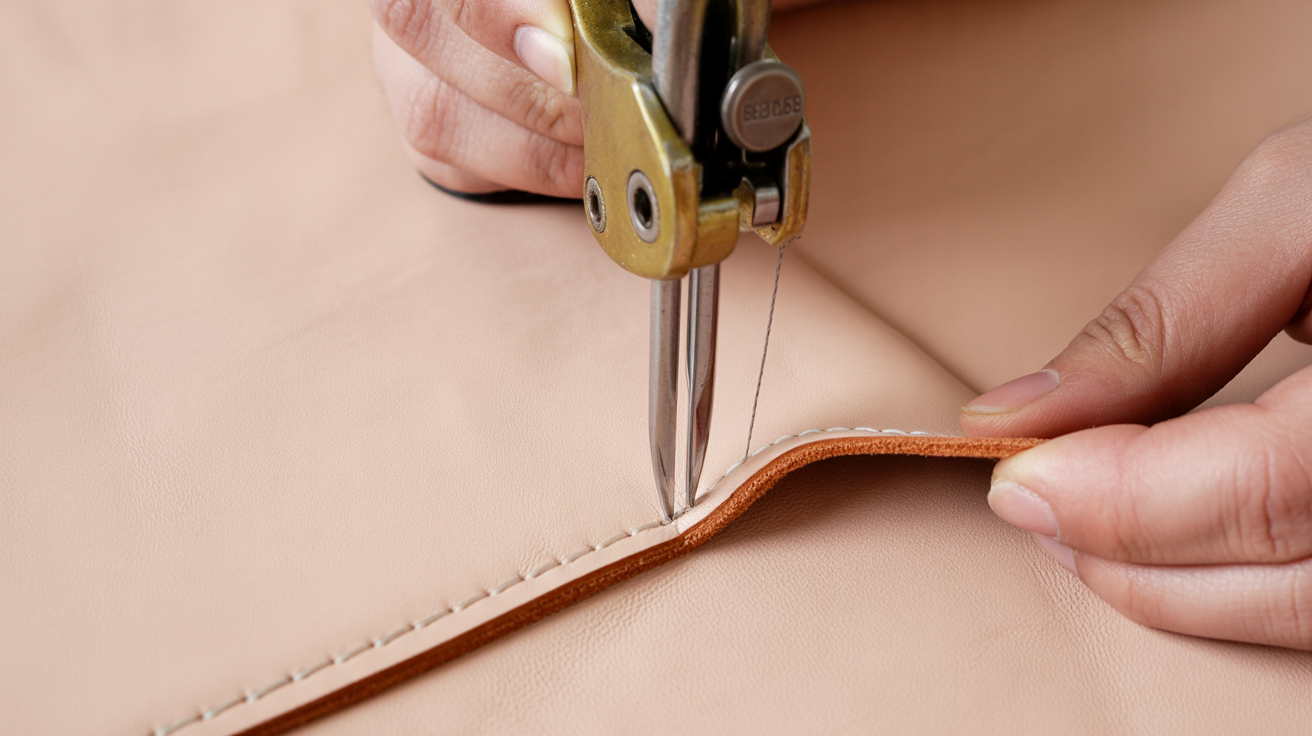
Finishing a leather stitch is the step most beginners rush, and it shows. A seam that ends with a loose knot will loosen and unravel with use. Do it right and the thread tucks into the leather permanently, almost invisible. Here is exactly how.
Why the Lock-Off Matters
Leather thread, whether waxed linen or polyester, does not grip itself the way fabric thread does. There is no interlocking loop like a sewing machine produces. A saddle stitch holds because two needles pass through the same hole from opposite sides, creating a figure-eight pattern. But at the last hole, that pattern has to be anchored or it will simply pull through.
The backstitch-and-lock method takes less than a minute once you know it. It uses the thread itself as the anchor, buried inside the stitch holes, so there is nothing protruding to catch or fray.
Finishing Supplies You Will Need
Before you reach the end of a seam, have these ready:
- A lighter or candle (for polyester thread) or a burnishing tool (for linen)
- Small scissors or a thread burner
- A blunt needle if you want to help tuck thread ends
That is it. No glue, no extra hardware.
The Standard Backstitch Lock-Off
This works for any hand-stitched leather seam. The goal is to run your thread backward through two or three completed holes before cutting, which traps the working end against itself under tension.
Step 1: Stitch to your final hole. Pull both needles through the last hole as usual so the thread is snug and even on both sides.
Step 2: Backstitch one hole back. Take one needle and pass it back through the second-to-last hole from the same side it exited. Pull through until the loop is almost closed, then pass the needle through the loop before pulling tight. This creates a half-hitch around the existing thread in that hole.
Step 3: Repeat on the other side. Do the same with the second needle on its side, going through the same hole or the third-to-last hole. You now have both thread tails anchored.
Step 4: Pull the tails tight. Tension is what locks everything in place. Pull each tail toward the seam, not away from it, so they seat flat.
Step 5: Trim close and melt or burnish. Cut the tails as close to the leather surface as possible. For polyester thread, briefly touch a lighter flame to the cut end to melt a small bead that hardens against the leather. For waxed linen, press the cut end with a hot burnisher or the side of a bone folder rubbed firmly to fuse the wax.
Locking Off a Saddle Stitch: The Two-Needle Version
If you have been following the classic saddle stitch method, you have two needles working at once. The lock-off happens with both.
At the last hole, both needles have crossed through. Now:
- Take needle A and run it through the second-to-last hole from front to back.
- Take needle B and run it through the same hole from back to front, crossing over needle A's thread inside the hole.
- Pull both needles until the thread is snug.
- Run each needle one more hole backward if you want extra security on thick leather or high-stress seams.
- Trim and seal as described above.
The crossing threads in that second-to-last hole grip each other under tension. It is the same principle as a reef knot, but flattened inside the leather rather than sitting on top.
Common Mistakes and How to Fix Them
| Mistake | What Happens | Fix |
|---|---|---|
| Trimming before melting | Thread end pops back through the hole with use | Melt or burnish before you trim final length |
| Only one backstitch hole | Lock-off pulls free on flexible seams | Always use at least two holes back |
| Pulling tails outward | Thread pulls through rather than locking | Pull tails toward the seam, along the stitch line |
| Melting too long | Thread beads too large, sits proud of surface | One second of flame only; the bead should be tiny |
| Skipping the lock on short seams | Short seams unravel faster, not slower | Every seam needs a lock-off regardless of length |
Preparing the Seam for a Clean Finish
A well-finished lock-off starts before you thread the needle. The cleaner your holes, the easier the thread seats at the end.
If you used pricking irons or stitching chisels to mark your holes, the spacing will be consistent and each hole will have a slight bevel that guides the thread. Irregular holes, which happen when you rush or drift off your stitch line, make the lock-off harder because the thread exits at odd angles.
Similarly, clean leather edges matter here. If the leather is frayed at the edge near your last hole, the thread has nothing solid to lock against. Take a few seconds to bevel and burnish the edge before you close the seam.
Frequently Asked Questions
Do I have to backstitch, or can I just tie a knot?
A surface knot works in a pinch, but it catches on things, loosens over time, and looks unfinished. The backstitch lock-off takes only a few extra seconds and is completely hidden once trimmed. Use it every time.
How many holes back should I go?
Two holes back is standard for most leatherwork. For seams under repeated stress, like a belt loop or a bag handle attachment, go three holes back or do two full passes.
My thread keeps slipping out before I can tighten it. What am I doing wrong?
You are likely pulling the wrong direction. The tails need to go toward the stitch line, not away from it. Try holding the seam flat and pulling each tail parallel to the leather surface as you seat the lock.
Can I use super glue instead?
A tiny drop of leather cement or flexible CA glue on the thread end before trimming is acceptable for linen thread on non-flex seams. It is not a substitute for backstitching, but it adds insurance. Do not skip the backstitch and rely only on glue.
What is the difference between locking off linen versus polyester thread?
Polyester thread responds well to heat: a brief touch of flame melts the end into a small bead that cannot pass back through the hole. Linen does not melt, so you rely on the backtack plus friction from the wax coating. Press the cut linen end firmly with a hot burnisher or the face of a clothes iron on low through a damp cloth. Both methods hold reliably when the backstitch is done correctly first.