How to Set Rivets in Leather (Without Wrecking Them)
Learn how to set rivets in leather correctly—rapid rivets, copper rivets, and Chicago screws—with the right post length, hole size, and technique.
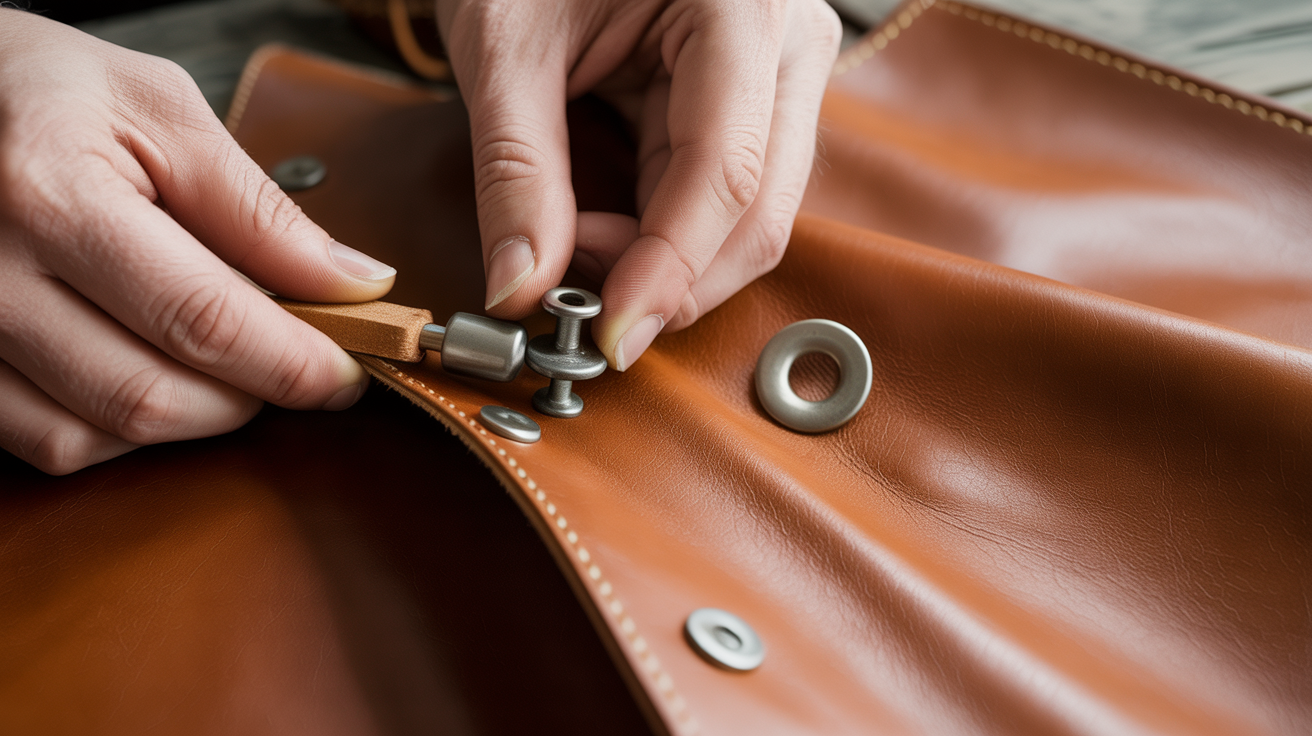
Pick the wrong post length, swing too hard, or skip the anvil block, and you'll end up with a rivet that folds sideways, mars the cap, or punches straight through. Getting rivets right is mostly a matter of matching the hardware to the leather and following a short sequence correctly. Here's how.
The Three Rivet Types Every Beginner Should Know
Not all rivets work the same way, and choosing the wrong type for a project is a common source of frustration.
Rapid Rivets (Double-Cap and Single-Cap)
Rapid rivets are the most beginner-friendly option. They come in two styles:
- Double-cap rapid rivets have a cap on both sides. A post sits on one piece and a separate cap goes on the other, so both faces look finished. Good for straps, belts, and anything where both sides are visible.
- Single-cap rapid rivets have a cap on one side and a plain flat back. Faster to set, cheaper, and fine when the back will be hidden (inside a bag lining, underside of a strap).
Both types are set by placing the post through the punched hole, seating the cap on top, and striking with a rivet setter. No peening, no special skills. Just a clean strike.
Copper Rivets and Burrs
Copper rivets are older, stronger, and more permanent. The rivet is a copper nail; the burr is a small copper washer that you push down the shaft, then peen (mushroom) the end over to lock it in place.
Copper rivets are the standard choice for harness work, heavy leather goods, and anything that will take real mechanical stress. They're overkill for a slim wallet but essential for a horse collar or thick belt. They take a bit more practice to set cleanly.
Chicago Screws (Screw Posts)
Chicago screws are two-part threaded posts that screw together. No hammer required. They're removable, which makes them useful for straps that need occasional swapping (guitar straps, watch bands) or for closures on items where you want to replace the leather later. The downside: they can loosen over time, especially on items that flex a lot. A small dab of thread-locking compound fixes that.
| Rivet Type | Setting Method | Reversible? | Best For |
|---|---|---|---|
| Double-cap rapid rivet | Setter + hammer | No | Belts, straps, decorative work |
| Single-cap rapid rivet | Setter + hammer | No | Hidden backs, quick construction |
| Copper rivet + burr | Hammer + peening | No | Heavy load-bearing leatherwork |
| Chicago screw | Hand-tighten | Yes | Swappable straps, flat closures |
Matching Post Length to Leather Thickness
This is the step beginners most often skip, and it's the main reason rivets fail. If the post is too short, you can't form a proper head. If it's too long, you'll have a wobbly shaft that bends instead of setting.
The rule: the post should clear the top of your leather stack by approximately the same distance as the cap height. For most rapid rivets, that's about 2–3 mm of post above the leather. For copper rivets, you want enough shaft above the burr to form a mushroom head, roughly 3–4 mm depending on the rivet diameter.
Measure your total leather stack (all layers being joined) with calipers before buying hardware. Understanding leather weights and thicknesses will help you predict how your specific leather will stack before you cut anything.
Rapid rivets typically come in short, medium, and long post lengths. When in doubt, err slightly long and trim the excess with flush-cutters before setting. This is much easier with copper rivets than with rapid rivets, where the post is already formed.
Punching the Right Hole
The hole diameter should match the rivet post snugly. Too tight and you'll struggle to push the post through; too loose and the rivet will wobble and never seat properly.
For rapid rivets, use a drive punch one size up from the post diameter as a starting point, then test on scrap. The post should push through with light thumb pressure, not force, and not fall through on its own.
For copper rivets, the hole should grip the nail's shaft firmly. If the rivet spins when you try to peen it, the hole is too large.
Always punch on a hard surface. A marble tile or a steel plate works well; a rubber cutting mat will let the punch deflect and produce a ragged hole. Use a mallet, not a hammer. One clean strike is better than multiple taps.
Place your punch perpendicular to the leather surface. A canted punch produces an oval hole, which causes the rivet to lean.
Setting Rapid Rivets Step by Step
- Punch the hole through all layers being joined, aligned carefully.
- Push the post up through the back of the leather, so the wide base sits against the back face.
- Place the cap on the post on the front face. It should click slightly into place.
- Set the cap on your anvil or poundo board, cap-side down. A poundo board is a dense rubber block that protects the cap face without marring it. A steel bench block or smooth steel plate works too. The goal is a surface hard enough to resist the strike without scratching the cap.
- Place the rivet setter over the post. A rivet setter is a short steel rod with a concave dimple at the tip that matches the post diameter. It guides the post into the cap without spreading it sideways.
- Strike the setter with a mallet. One firm hit, check the result, then a second if needed. The post should flare into the cap's recess and lock flush. You'll feel the resistance change when it sets.
Avoid steel hammers on the setter if you're new. A rawhide or wooden mallet gives you slightly more control and makes over-striking less likely.
Setting Copper Rivets and Burrs
- Punch the hole as above.
- Push the rivet through from the front, head-side down against the face.
- Slide the burr (washer) down the shaft, flush against the back face of the leather. A burr setter, a small cupped tool, makes this easier. Tap it firmly so the burr seats against the leather.
- Trim the shaft if it extends more than about 4 mm above the burr. Flush-cutters or nippers work well. Leaving too much shaft creates a tall, narrow peen head that can crack rather than spread.
- Place the rivet head against a solid anvil, such as a steel bench block or rivet anvil. The head must be fully supported or it'll sink into the leather.
- Peen the shaft. Use a ball-peen hammer (or the cross-peen of a riveting hammer), striking the end of the shaft with glancing blows outward from the center. Work around the shaft in a circle, gradually mushrooming the copper. Don't try to flatten it in one heavy blow. Copper work-hardens quickly and will crack if you rush it. You want a domed head that covers the burr hole.
- Finish with a flat hammer face to smooth the head if needed.
The quality of a peened rivet depends mostly on the anvil support. If the head isn't sitting on something solid and flat, the leather absorbs the energy and the rivet won't set tight.
Why Rivets Go Wrong (and How to Fix It)
The rivet folds over sideways. The post is too long, or you struck off-center. With rapid rivets, a setter that's too large lets the post wander. Use the correct setter size.
The cap face is marred or dented. You put the cap face-down on a hard steel surface. Always use a poundo board or a leather scrap to protect it.
The rivet sets loose and wiggles. The post was too short to fully engage the cap, or the hole was too large. Test your post length on scrap before committing.
The copper rivet shaft cracked when peening. You hit too hard too fast, or left too much shaft. Copper work-hardens, so use lighter, more frequent blows and work around the shaft rather than striking straight down.
The rivet sits crooked. The punch hole wasn't perpendicular, or the leather stack wasn't flat when you set it. Clamp or firmly hold layers together before punching.
The Chicago screw keeps loosening. Apply a small amount of thread-locking compound to the threads before final assembly.
Different leathers behave differently under hardware. Vegetable-tanned leather is firmer and holds a rivet hole more cleanly than chrome-tanned, which tends to be softer and can stretch slightly under the post. If you're working with an unfamiliar hide, understanding the difference between veg-tan and chrome-tan leather will help you anticipate how it'll respond to hardware.
Tools to Have Before You Start
You don't need much, but skipping any of these creates problems:
- Drive punches in the right size, matched to your rivet post diameter
- Rivet setter matched to your rivet post size (a mismatched setter is a common cause of crooked sets)
- Poundo board or similar to protect cap faces
- Steel bench block or rivet anvil for solid backing
- Rawhide mallet for rapid rivets, and/or ball-peen hammer for copper rivets
- Calipers to measure leather stack thickness before choosing post length
- Flush-cutters for trimming copper rivet shafts
FAQ
What size rivet should I use for a leather belt?
For a standard 8–10 oz belt (roughly 3–4 mm thick), a medium post rapid rivet usually works well. If you're joining two layers such as a doubled belt end, measure the combined thickness and add 2–3 mm for the post clearance. Copper rivets are a good choice for belt keepers and loops that take real tension.
Can I set rivets without a setter tool?
You can improvise with a nail punch or a smooth rod of the right diameter, but a proper rivet setter makes a clean result much more reliable. Setters cost a few dollars and match standard rivet sizes. They're worth having.
Do I need a special anvil?
Not necessarily. A smooth, flat steel bench block works fine for both rapid rivets and copper rivets. A poundo board is useful for rapid rivets specifically because it protects the cap face. Avoid setting rivets on soft surfaces like cutting mats, since the surface gives way and the rivet never seats properly.
How do I choose between rapid rivets and copper rivets?
If you want something quick, decorative, or on a project that won't see heavy use, rapid rivets are the right call. If the joint will take real mechanical stress (a load-bearing strap, a harness, anything that flexes repeatedly), copper rivets are stronger and more durable. The peening technique takes practice but produces a joint that's nearly impossible to pull apart.
My rivet holes are tearing out. What am I doing wrong?
This usually means the leather is too thin for the rivet size, the hole is too close to an edge, or the leather type is too soft to hold the hardware. As a general rule, keep rivets at least 6–8 mm from any edge. If you're working with thin or soft leather, consider reinforcing the back with a layer of firm backing leather. You can also see how different hide sections vary in density, which affects how well they hold hardware.